


#Summary
This brief provides an update on the resulting changes to USDtb’s control model, based on publicly available sources and limited clarifications received from the relevant parties. These findings are presented by LlamaRisk following additional due diligence conducted after our recent recommendation to reduce supply and borrow caps and the switch to pricing USDtb at a peg with USD on Aave’s Core market, which was prompted by observed fluctuations in secondary market stability.
As of October 13, 2025, the issuance, redemption, and reserve management of USDtb were transitioned to Anchorage Digital Bank (ADB). Ethena Labs, Pallas BVI, and ADB entered into a tripartite stablecoin services agreement governing their relationship. The transition effectively shifts the control model to a regulated banking framework. Key changes include a tri-party agreement governing issuance, the establishment of a dedicated Reserve Trust, and a clear legal distinction between token holders and onboarded clients. This report details the implications of these changes on custody, legal recourse, and the operational risk profile of the stablecoin.
#Legal Characterization of USDtb Under the ADB Framework
ADB is a financial institution chartered by the U.S. Office of the Comptroller of the Currency (OCC) to provide institutional-grade digital asset custody, staking, trading, and settlement services. Under ADB’s Covered Stablecoin Terms, ADB is the issuer of “Covered Stablecoins” (potentially comprising multiple “Series” with different names, designations, or identifiers) on blockchain networks selected by ADB, with a par value of USD $1.00 unless expressly stated otherwise. ADB characterizes Covered Stablecoins as digital assets issued for payment and settlement, not designed to appreciate in value or generate investment returns, and not constituting legal tender. ADB further states that the stablecoins are not insured by the FDIC, NCUA, or SIPC and are not government-backed.
ADB expressly positions itself as the “sole issuer” and “sole obligor” for each Series, even where it engages third-party service providers and/or brand partners. This seeks to concentrate holder-facing liability at ADB and to disclaim agency relationships or recourse against partners (including any “Brand Partner,” as Ethena may be treated).
ADB states that all Covered Stablecoins are backed by reserve assets with an aggregate market value at least equal to the outstanding tokens as of the end of each business day and that the reserve is held in a South Dakota express trust (the “Reserve Trust”), with ADB serving as trustee and owing fiduciary obligations. ADB’s fiduciary duties include, among other matters, maintaining adequate reserves to satisfy redemption obligations. ADB further states that returns on the reserve in excess of what is required to maintain 1:1 backing constitute ADB’s fiduciary compensation for administering the Reserve Trust.
The Terms of Use on the USDtb website identify the site operator as “Pallas (BVI) Ltd” and apply BVI law and arbitration to site use; they also state that the site is informational only and does not offer financial products, services, or transactions. This design choice may be explained by an intended separation between (i) an informational website operated by a BVI entity and (ii) the stablecoin issuance and redemption activity conducted by ADB under ADB’s terms. It may be assumed that Ethena and/or Pallas retain operational latitude with respect to USDtb distribution, provided such activity remains lawful at all times and does not conflict with ADB’s risk and compliance framework.
#Tokenholders’ Rights and Obligations
ADB’s two-tier holder model draws a hard distinction between: (a) “Clients” (customers under ADB’s Master Account Agreement) who can issue and redeem with ADB, and (b) “Non-Clients” who can hold and transact on-chain but have “no contractual relationship” with ADB under the Terms and “no enforceable rights” against ADB, except as may arise under applicable law.
Clients’ issuance and redemption rights arise under (i) the Master Account Agreement (not publicly accessible) and (ii) the ADB Covered Stablecoin Terms (incorporated by reference into the Master Account Agreement). A transfer of tokens transfers “all rights associated with those Covered Stablecoins,” but the “conditional right to redeem” becomes exercisable only if and when the recipient becomes an ADB Client. Consistent with this portability statement, USDtb is transferable, while “direct redemption” is gated through onboarding and the Master Account Agreement.
Consequently, the list of whitelisted minters and redeemers is now strictly limited to entities that have successfully onboarded as ADB Clients. This means that the previously available onchain whitelist has now been deprecated, with no transparent way to observe the entities that are able to perform secondary-to-primary market arbitrage.

Source: Etherscan, February 25, 2026
At the same time, the Terms impose law-compliance conditions (including sanctions, prohibited jurisdictions, and unlawful activity) and confer broad powers to freeze, block, seize, or otherwise restrict tokens where required by law or where ADB determines a transfer violates or is likely to violate applicable law or regulation—expressly stating that such measures may apply to Clients and Non-Clients alike and may result in permanent loss of access.
ADB commits to redeem “exclusively from Clients” and to issue “exclusively to Clients.” ADB states that issuance and redemption occur at par value net of fees (pursuant to a separate fee schedule) and that processing is undertaken on “commercially reasonable efforts,” subject to delays or suspensions for verification, compliance, operational or technical issues, and (for redemptions) “liquidity management,” among other reasons. ADB’s redemption procedures, labeled the “Redemption Policy,” are designed to satisfy the GENIUS Act’s “timely redemption” requirement.
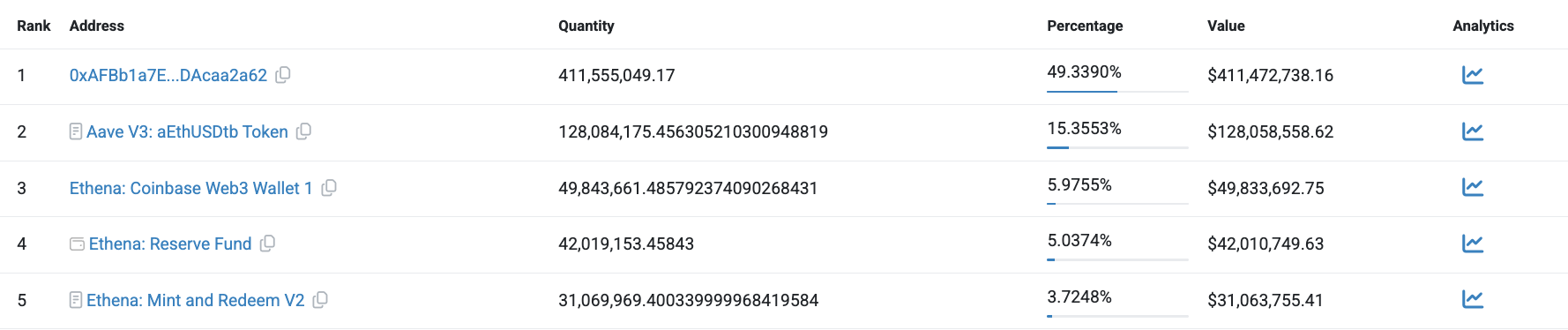
Despite these changes, Ethena remains among the top USDtb holders, with holdings in the primary USDe backing, the USDe mint and redeem contract, and the reserve fund. 128M tokens remain deposited in Aave’s Core market, where Ethena is the sole large supplier.
Source: Etherscan, February 25, 2026
#Reserves
USDtb reserve holdings are disclosed on a monthly basis. Attestation reports are provided by a Big Four independent third-party accounting firm and are prepared in accordance with attestation standards established by the American Institute of Certified Public Accountants (AICPA).
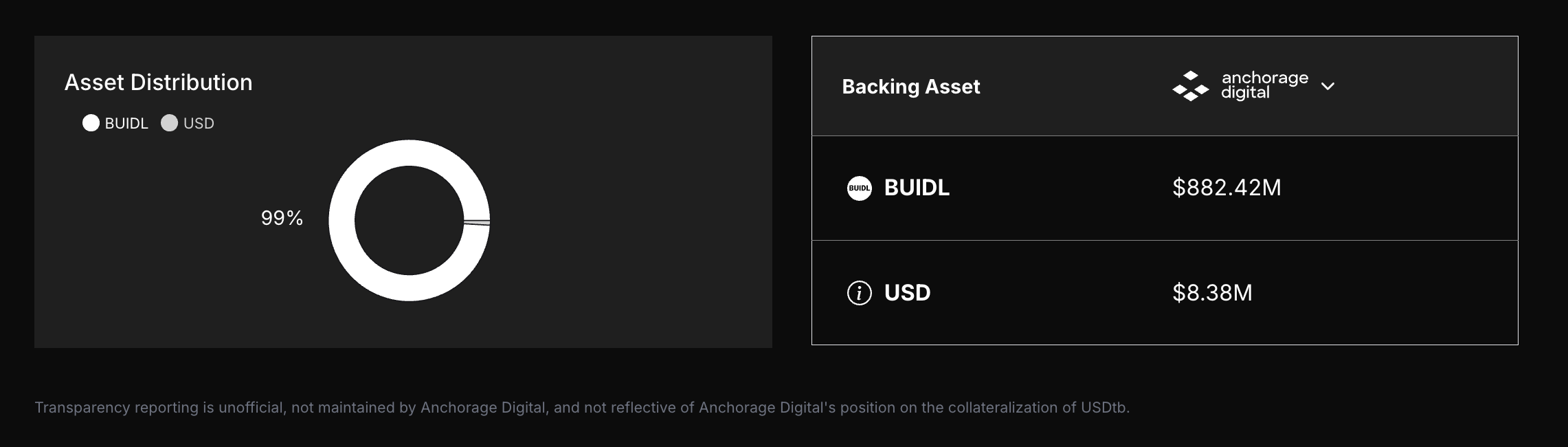
As of December 31, 2025 (11:59:59pm UTC), Anchorage reports 843,833,038 USDtb redeemable tokens outstanding and total reserve assets of $845,264,256, implying a surplus of $1,431,218. Reserves are reported as $12,260,730 in cash and $833,003,526 in BUIDL (fair value). No reserve attestation is available for the month of January, representing a lapse in transparency.
Notably, this transition has resulted in a material change in reserve composition compared to the pre-transition period. This represents a shift from onchain redemption servicing model to a model where the assets are self-custodied by Anchorage, with USD redemptions settled offchain in fiat. Therefore, instant redemption guarantees are not provided to the tokenholders anymore.
Source: usdtb.money Dashboard, February 25, 2026
This structure is directionally consistent with the GENIUS Act’s prescriptions on eligible reserves, namely that reserves may consist of cash or Federal Reserve balances, demand deposits, short-dated U.S. Treasuries, Treasury-backed overnight repo or reverse repo, and registered government money market funds invested solely in those underlying assets, plus a limited regulator-approval bucket.
The attestation affirms that the reserve assets are maintained in segregated fiduciary trust accounts that are unencumbered and held on behalf of USDtb token holders in one or more of the following forms: (i) fiat currency held in Federal Deposit Insurance Corporation (FDIC)-insured bank accounts; and (ii) BUIDL self-custodied by Anchorage in segregated wallets.
The GENIUS Act requires reserves to be “identifiable” and also prohibits pledging, rehypothecation, or reuse except for narrow operational exceptions. Accordingly, the attestation disclosures support GENIUS-aligned outcomes, including operationally separated reserves (supporting “identifiable reserves”), “unencumbered” reserve posture consistent with the non-rehypothecation principle, and a custody design compatible with GENIUS’ insistence that reserves not be used as general operating assets.
ADB, in its capacity as trustee of the Reserve Trust, has fiduciary obligations to invest and manage the reserves prudently and in accordance with applicable South Dakota trust law, applicable federal banking law, and other applicable law. ADB’s fiduciary duties include, but are not limited to, maintaining adequate reserves to satisfy redemption obligations. All income, gains, or other returns realized on the reserves beyond the amounts necessary to maintain reserves sufficient to back outstanding Covered Stablecoins on at least a one-to-one basis constitute fiduciary compensation to ADB for administering the Reserve Trust.
#USDtb Minting & Redemption Pathways
While the formal ADB framework establishes a gated Client-only primary market, the post-transition model in practice provides two distinct pathways for acquiring and exiting USDtb, each targeting different user profiles.
#Path 1: Atomic Swap via USDe (for Ethena-onboarded users)
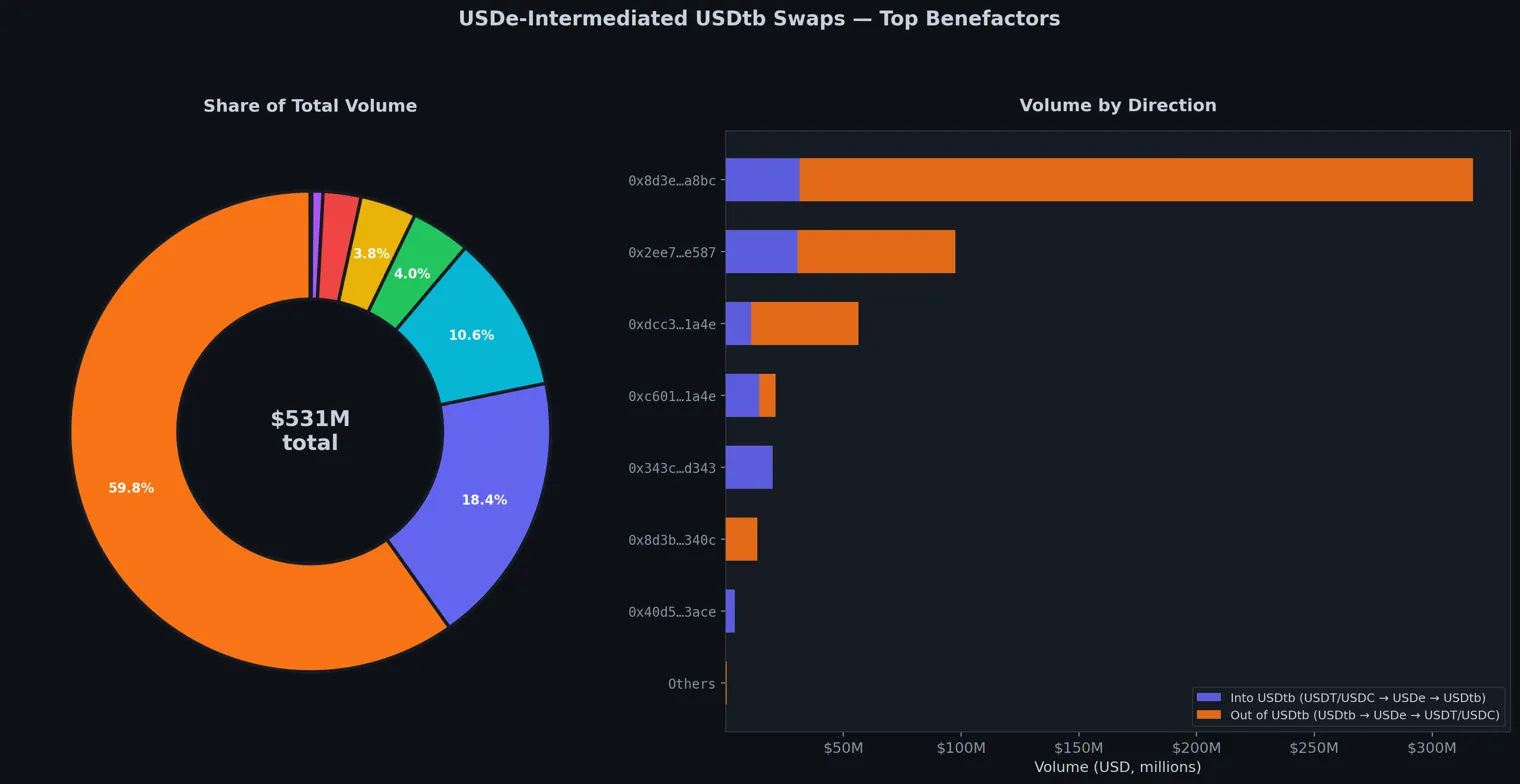
Users who are onboarded to mint and redeem USDe using USDT or USDC can atomically swap their stablecoins for USDtb and vice versa, leveraging USDe as an intermediary across two transactions. The USDe mint/redeem facility is available 24/7/365 on demand with atomic settlement upon available instant redemption capacity.
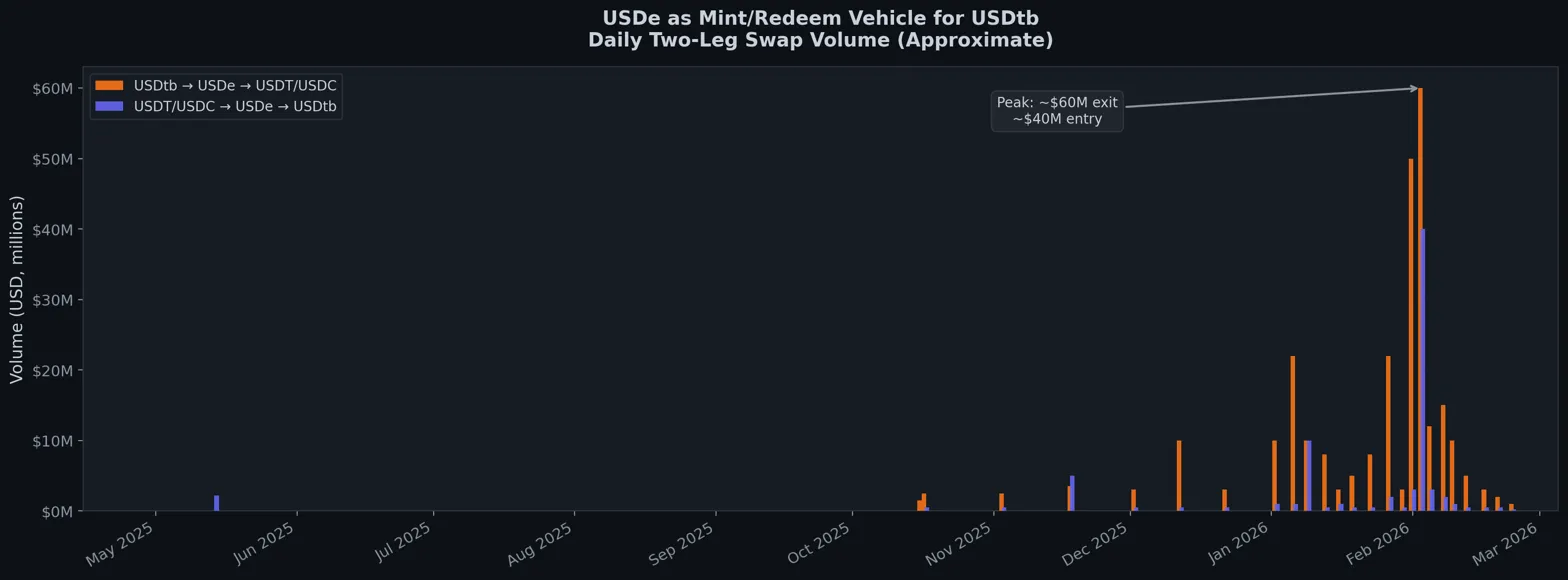
For example, a user wishing to swap USDT for USDtb would: (1) use USDT to mint USDe, then (2) redeem USDe for USDtb. The reverse flow applies for exiting USDtb into USDT or USDC, at a current fee of 10 bps for the two-step process. Historically, these swaps have been actively used in practice, generating around 500M of USDe mint/redeem volume.
Source: LlamaRisk, February 25, 2026
This pathway is significant from a peg stability perspective because it provides an onchain arbitrage mechanism that does not require ADB Client onboarding. However, it is worth noting that this route depends on sufficient liquidity in the USDe mint/redeem facility and introduces indirect exposure to USDe mechanics during the swap. As of the time of writing, the EthenaMinting V2 contract holds approximately $31.1M in USDtb alongside comparable USDT and USDC balances. USDe has started to actively be used as a mint & redeem vehicle for USDtb starting from November 2025, shortly after USDtb ownership was transferred to ADB.
Source: LlamaRisk, February 25, 2026
#Path 2: Fiat Mint & Redeem via Anchorage Digital Bank (for ADB Clients)
Users onboarded with ADB can mint and redeem USDtb for fiat USD at 1:1, with no fees. The redemption process operates as follows: users deposit USDtb with ADB, which is credited instantly with 24/7/365 availability. Once credited, redeem requests are fulfilled within 15 minutes around the clock, with fiat USD credited to the user's ADB account. Users can withdraw their fiat USD immediately thereafter.
Approximately 1% of USDtb backing assets (roughly $10M at the current ~$800M supply) is held in cash to facilitate instant redemptions. This fiat backing can be replenished in unlimited size within hours on business days (Monday–Friday during U.S. banking hours), given the speed at which BUIDL redemptions can be processed. ADB also offers yield-bearing accounts for fiat deposits, providing an ancillary incentive for Client onboarding.
This pathway provides a stated 15-minute turnaround and a standing cash buffer. However, the 1% cash allocation imposes a practical ceiling on instantaneous large-scale redemptions, with replenishment constrained to U.S. banking hours. Under stress conditions—such as a rapid depeg or a mass exit scenario—the queue-based offchain settlement could introduce delays beyond the stated 15-minute window, particularly if the cash buffer is exhausted during non-banking hours or weekends. This is particularly relevant to Ethena itself, in case a large portion of USDtb held in the USDe backing would need to be redeemed.
#Conclusion
From a legal and compliance perspective, the post-transition model presents significant changes. The regulatory posture is significantly stronger owing to reserves held in a South Dakota express trust with ADB as trustee, GENIUS-aligned custody standards, and a clearly defined issuer-obligor framework under a nationally chartered bank.
The transition has introduced trade-offs in operational transparency. The deprecation of the onchain whitelist renders the ADB primary issuance and redemption market less observable. However, this opacity is partially mitigated by the continued availability of the USDe-intermediated atomic swap pathway, which provides an onchain arbitrage mechanism accessible to Ethena-onboarded users at a cost of 5 basis points per interaction.
Similarly, while the shift from atomic onchain settlement to offchain banking rails removes the previous instant redemption model for ADB's fiat pathway, the stated 15-minute redemption turnaround and standing ~$10M cash buffer represent a more credible redemption commitment than initially apparent from the formal terms alone. The practical limitation lies in the cash buffer's capacity relative to outstanding supply and its dependence on U.S. banking hours for replenishment.
The remaining concerns center on transparency and reporting. The missing January attestation represents a lapse that undermines confidence in the post-transition framework's accountability standards. Going forward, timely and consistent reserve reporting will be essential to maintaining trust in the regulatory benefits the ADB framework is designed to provide.